

Ar. A Delli Babu
Founder Principal
As India’s urban footprint expands at an unprecedented pace, the architecture and construction industry is confronting a defining question: how can growth coexist with environmental responsibility? According to the International Energy Agency (IEA), buildings and construction account for nearly 37 percent of global energy-related carbon emissions, while India is projected to add billions of square feet of built-up area over the next decade.
The urgency for climate-responsive architecture is no longer theoretical; it has become central to how cities will function, consume resources, and sustain future generations. Increasingly, clients, developers, and policymakers are seeking architects who can balance energy efficiency, environmental stewardship, operational viability, and contemporary aesthetics within the same blueprint.
Against this backdrop, one such architect leading this transition is Ar. A. Delli Babu, Founder Principal of DB Architects Private Limited, whose work has steadily positioned him as one of the more thoughtful voices in India’s sustainable design.
What distinguishes Ar. A. Delli Babu is not merely his adoption of green building principles, but the discipline with which sustainability is embedded into the earliest stages of planning and execution.
His approach avoids treating sustainability as a cosmetic layer or certification-driven exercise. Instead, it is integrated into orientation studies, material selection, water management, energy systems, ventilation planning, and lifecycle performance from the outset.
Over the years, his studio has built a reputation for designing spaces that are environmentally conscious without compromising commercial practicality or visual sophistication. In an industry often driven by rapid timelines and short-term cost calculations,
Ar. A. Delli Babu advocates a more measured philosophy, one where buildings are evaluated through their long-term environmental and social consequences rather than immediate visual impact alone.
His recognition as a Sustainable Architect – 2026 therefore arrives at a particularly relevant moment for the industry. It reflects not only his personal journey as an architect, but also the growing acknowledgment that future-ready architecture in India must be climate-responsive, resource-efficient, and deeply contextual to local conditions.
Purpose Before Design
For Ar. A. Delli Babu, the shift towards sustainable architecture was gradual but transformative. After founding Design Studio in 2005, his early years largely reflected the conventional expectations of the market projects focused on aesthetics and client preferences, but without a strong sustainability framework. That changed during the late 2000s, when the industry began witnessing landmark developments in green construction practices.
A pivotal influence was the emergence of the CIISohrabji Godrej Green Business Centre in Hyderabad, widely recognized as India’s first LEED Platinumrated green building.
The project demonstrated that sustainability could produce measurable operational outcomes, including substantial reductions in energy consumption and water usage. For Ar. A. Delli Babu, it fundamentally altered the way architecture could be perceived, not simply as spatial design, but as a longterm environmental system.
This evolving perspective eventually shaped the formation of DB Architects Private Limited and his professional specialization as an IGBC-Accredited Professional. Since then, sustainability has become less of an optional service offering and more of a foundational design philosophy across the firm’s residential and commercial projects.
What particularly defines his approach is the belief that sustainability, functionality, and aesthetics are not competing priorities. In his view, intelligent planning naturally aligns all three. A properly oriented building, for instance, reduces heat gain and dependence on artificial cooling systems, allowing budgets to be redirected towards materials and finishes that enhance user experience. Rather than adding sustainability features after design completion, his team integrates environmental performance at the concept stage itself.
This philosophy also reflects a broader critique of contemporary urban architecture in India.
Ar. A. Delli Babu frequently points to the mismatch between imported global design trends and India’s climatic realities. Glass-heavy facades inspired by Western skylines, while visually aspirational, often perform poorly in Indian weather conditions, increasing cooling loads and operational inefficiencies. His design approach instead prioritizes climate responsiveness through natural ventilation, shading systems, daylight optimization, and contextual planning.
Among the projects that best represent Ar. A. Delli Babu’s sustainability philosophy is Sumadhura Sushantham in North Bengaluru’s Vidyaranyapura Sahakara Nagar corridor
Designing with Consequence
At DB Architects Private Limited, projects are evaluated through what Ar. A. Delli Babu describes as three interconnected lenses: social, economic, and environmental. This framework has become central to the firm’s identity and differentiates it from purely aesthetics-driven practices.
Socially, the focus remains on how built spaces shape everyday human experiences. Economically, projects are designed not only around construction budgets but also long-term operational affordability. Environmentally, every design decision is assessed through resource efficiency and lifecycle impact.
This philosophy translates into practical interventions across materials, water systems, and energy strategies. The firm routinely incorporates fly-ash blended concrete, AAC blocks, locally sourced stone, and low-VOC paints into its projects. Passive design principles, including orientation optimization, cross-ventilation, and shading analysis, form the first layer of energy strategy before mechanical systems are introduced.
Where required, these passive approaches are complemented by technologies such as VRV and VRF air-conditioning systems, rooftop solar integration, LED lighting, BLDC fans, and water recycling systems. Rainwater harvesting and greywater reuse have also become standard considerations within commercial developments undertaken by the firm.
Importantly, Ar. A. Delli Babu measures sustainability through operational outcomes rather than symbolic certification alone. A successful building, in his assessment, is one that meaningfully reduces monthly electricity and water consumption for its occupants. This operational pragmatism has allowed his firm to position sustainability not as an elite premium offering, but as a financially rational and environmentally necessary approach to modern construction.
Technology and Judgement
Like much of the contemporary architecture sector, DB Architects has increasingly integrated digital technologies into its workflow.
However, Ar. A. Delli Babu remains careful not to position technology as a substitute for architectural judgement.
Building Information Modelling (BIM) has become standard practice for larger-scale projects within the firm, allowing coordination between architectural, structural, and MEP systems before execution begins on site. Energy modelling tools are used to simulate annual building performance, enabling data-driven decisions around glazing, shading, and orientation.
Visualization technologies have also improved client communication and reduced revision cycles by allowing stakeholders to experience spaces before construction begins. Meanwhile, emerging AIassisted workflows are beginning to support earlystage concept exploration and material estimation processes.
Yet despite this technological integration, Ar. A. Delli Babu maintains that the architect’s role remains fundamentally human. “Software may accelerate execution and improve precision, but the responsibility for balancing climate, context, economics, and user experience still rests with professional judgement. In an industry increasingly driven by automation and visual software capabilities, this balanced perspective reflects both restraint and maturity”, shares Ar. A. Delli Babu.
Building for Tomorrow
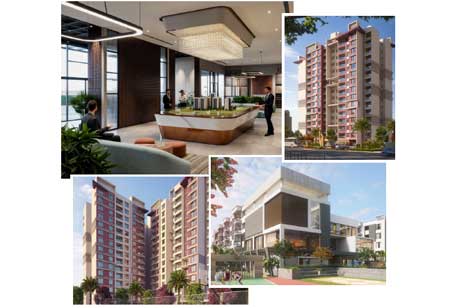
Among the projects that best represent Ar. A. Delli Babu’s sustainability philosophy is Sumadhura Sushantham in North Bengaluru’s Vidyaranyapura–Sahakara Nagar corridor. Conceived as a “Total Wellness Home” community, the development integrated environmental systems directly into its infrastructure planning rather than treating sustainability as a branding exercise.
The project incorporated a sewage treatment plant enabling complete reuse of treated water for flushing and landscaping, alongside rainwater harvesting and water-softening systems that significantly reduced freshwater dependence. Energyconscious interventions included solar-powered common lighting, EV charging infrastructure, and energyefficient elevator systems using V3F drives.
Architecturally, nearly three-fourths of the land parcel was retained as open green space, while apartment planning emphasized daylight access and cross-ventilation. Landscape planning further reinforced environmental responsiveness through kitchen gardens, medicinal plant zones, aromatic gardens, and shaded tree courts designed to moderate microclimatic conditions.
For Ar. A. Delli Babu, projects such as these demonstrate what becomes possible when clients engage with sustainability as a long-term value proposition rather than a cost burden. It also reflects his broader vision for the future of Indian architecture.
He believes India is approaching a critical inflection point where sustainable design practices must transition from voluntary adoption to regulatory baseline. Frameworks such as the Energy Conservation Building Code (ECBC) and GRIHA have already established meaningful direction for commercial developments. However, he advocates for more comprehensive national-level sustainability standards applicable across residential and commercial construction alike.
At its core, Ar. A. Delli Babu’s philosophy remains rooted in accountability. Buildings, in his view, are not isolated design objects; they are long-term environmental consequences that outlive their creators. In an era where Indian cities face rising temperatures, resource stress, and accelerated urbanization, that perspective may ultimately define the next generation of responsible architecture.
We use cookies to ensure you get the best experience on our website. Read more...
Copyright © 2026 HomesIndiaMagazine. All Rights Reserved.