

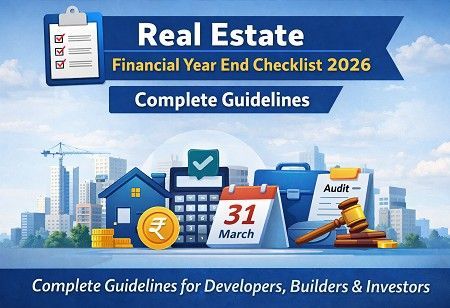
As the Financial Year End 2026 approaches, real estate developers, builders and property investors in India should aim at ensuring that they close their books accurately and fully compliant with statutory and regulatory frameworks. Because of the capital intense nature of the sector, the intricate revenue cycles and the regulation of the industry, a well-organized year-end checklist is paramount not only to ensure compliance but also to provide a clear financial status and investor trust.
If you are a developer with several projects to manage, or a real estate investment company about to undergo audits or funding, either way, this step-by-step guide will cover all that is needed to execute FY 2025-26 effectively and stay within the frame.
ROC Compliance for Real Estate Companies
Corporate regulations that companies have to follow:
Corporate Tax & Advance Tax Planning
Financial efficiency requires a tax strategy:
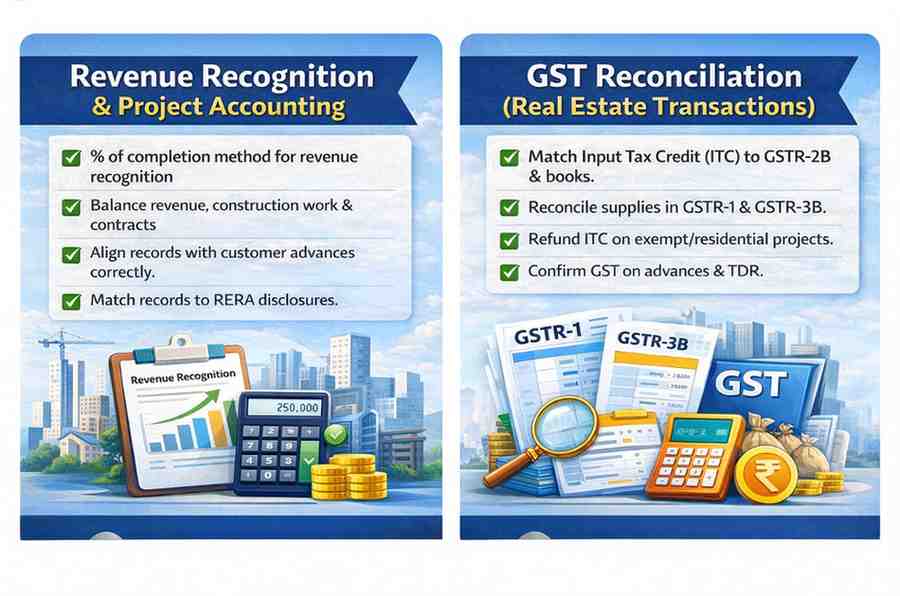
Audit-Readiness & Investment Impact
Financial close readiness guarantees audit-readiness - which is essential in real-estate companies that want to secure funds or establish relationships. Before committing themselves to projects, investors and lenders evaluate the viability of the project, track record of compliance, and financial discipline.
Proper reporting of the inventory, revenue and liabilities will save due diligence time and increase valuation opportunities.
Bottom Line
The end of year closure in the real estate business is a strategic process that is comprised of compliance, financial accuracy, and operational discipline. Under GST reconciliation and project accounting RERA compliance and tax planning, each process is important towards business continuity and credibility.
With a systematic Financial Year End Checklist 2026, real estate companies will be able to mitigate risks, prevent fines, and be in a position to grow and benefit sustainably and invest in an environment that is becoming highly regulated.
We use cookies to ensure you get the best experience on our website. Read more...
Copyright © 2026 HomesIndiaMagazine. All Rights Reserved.
