

The housing market in India starts 2026 on a more stable and sustainable basis following an acute post-pandemic growth. The increase in the price in key cities has been moderate, and this portrays a change from a sharp increase to normalization.
Although technology-driven markets like Bengaluru and Hyderabad still perform better, other metros are experiencing a slow appreciation that is selectively propelled by selective demand. This is because the market is becoming more influenced by the infrastructure investment, changing buyer behavior, affordability trends and the emerging trend towards quality-focused and professionally operated residential projects, making the industry vulnerable to long-term and sustainable growth instead of speculative ones.
Performance city-wise: Divergent growth patterns.
Bengaluru and Hyderabad were the top performers among the top eight cities and featured by strong end-user demand and long-term employment in the technology sector in 2025.
Bengaluru has experienced 13% price growth per annum, compared to 12% in 2024, and the best quarterly growth of 21% Q1 to Q4 2025, which has advanced average prices to 9500 per sq. ft. This made Bengaluru rank higher than Delhi NCR and the second most expensive residential market only to Mumbai MMR. Hyderabad came second with 8% growth, which is much better than 3% in 2024, with the growth due to infrastructure development, high IT recruitment, and better social facilities.
Conversely, the price increase in Mumbai MMR, though it is the most expensive market in India, increased significantly by 4 per cent in 2025 as compared to 18 per cent the previous year. This is an indication of consolidation in the high-end market since price pressure on affordability and high base rates dampened incremental demand. Pune had the lowest growth of 1 percent, as Chennai prices did not change year on year following a robust increase of 16 per cent last year.
Also Read: Budget 2026: Developers Seek Boost for Housing Demand
Delhi NCR and Kolkata recorded 6 per cent growth each, indicating the apprehensive but selective demand in well-established micro-markets, and Ahmedabad reported a calculated 8 per cent growth garnered by infrastructure-based growth and growing industrialization.
“Infrastructure-led growth corridors like the Yamuna Expressway and Navi Mumbai region gained prominence, boosting residential demand in previously under-served markets.” - Manoj Gaur, CMD, Gaurs Group
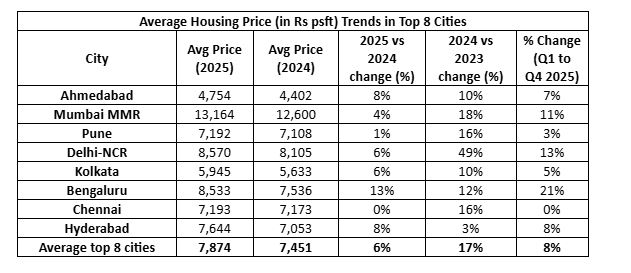
Source: PropTiger.com – Real Insight Residential CY 2025
Market commentary
Commenting on the trends, Onkar Shetye, Executive Director of Aurum PropTech, said: “Mumbai MMR price trends through 2025 reflect price consolidation in the region's premium market, while that of Pune and Ahmedabad remains broadly stable. Delhi NCR and Kolkata also saw measured price increases amid selective demand. Bengaluru and Hyderabad showed steady end-user demand and balanced absorption.”
This review is indicative of a wider market fact: though speculative momentum has dried, structurally sound cities where employment-based housing demand is high are still performing well.
Key drivers shaping the 2026 outlook
End-user-driven demand replacing investor-led cycles
The demand in the housing sector is becoming more end-users driven in the major cities, especially in Bengaluru, Hyderabad, and a few micro-markets of the NCR. Customers are also focusing on ready to move or near completed residential properties, improved developer balance sheets and those with better infrastructure connectivity and amenities.
Infrastructure and transit-led appreciation
The development of Metro rails, expressways, airport development, and integrated business districts continues to open new residential development centers. Markets such as Hyderabad, Ahmedabad, and peripheral Bengaluru are experiencing lasting demand due to infrastructure-driven demand as opposed to the price-cycle speculation.
Premiumisation and branded housing
There is an increasing demand for bigger homes, gated communities and professionally managed developments in the market. Branded homes, integrated townships, and lifestyle-based ventures are on the rise, especially among upper-middle and high-income earners who are buying houses and this is facilitating the value of enduring prices even in a moderated growth environment.
Also Read: The Evolution of Kitchen Electronics - 2026 & Beyond
Interest rates and affordability dynamics
The stable interest rates up to 2025 facilitated the consumption of housing although the prices rose in some markets. Though affordability has continued to be a pressure in high-end segments of Mumbai and Bengaluru, developers are slowly adjusting the size of units and product formats to maintain the sales pace.
“India’s real estate sector is entering 2026 with strong growth prospects, anchored by rising occupier activity, infrastructure-led connectivity and end-user demand.” -Badal Yagnik, CEO & MD, Colliers India
The future housing sector in India
The residential real estate markets in India are likely to be stable, discriminative, and structurally sound going into 2026. Instead of nationwide expansion of two digit performances, urban specifications will remain a performance characterization.
“2025 saw a transition to single-digit price growth as investor activity slowed and end-user fundamentals strengthened.” - Anuj Puri, Chairman, Anarock Group
Conclusion
The housing market of India in 2026 is an indication of a sector that has left the volatile cycles of the market and entered the phase of steady growth that is fundamentally driven. The fact that the increase in prices has slowed down from 17 percent in 2024 to 6 percent in 2025 is an indication of normalization and not a sign of weakness, as it demonstrates a more acceptable demand-supply curve.
As Bengaluru and Hyderabad become structural performers, Mumbai gathers at a high-quality level, and other metros provide consistent returns. Furthermore, the market is becoming more influenced by the preparedness of infrastructure, the confidence of end-users and tendencies of urbanization in the long-term. To buyers and developers, as well as investors, the residential sector of India in 2026 looks stable, choosy, and a sustainable opportunity, instead of the exuberance of speculation.
We use cookies to ensure you get the best experience on our website. Read more...
Copyright © 2026 HomesIndiaMagazine. All Rights Reserved.
