

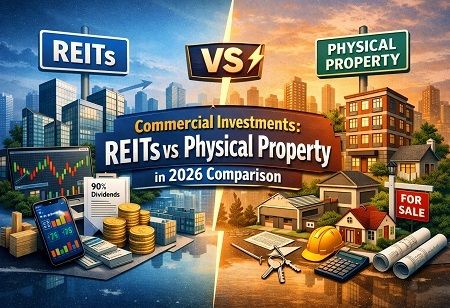
As commercial real estate trends in 2026 continue to evolve, the debate around REITs vs. Physical Property in 2026 is becoming central to modern investment strategies.
With the rise of digital economies, hybrid work models, and institutional-grade real estate products becoming accessible to retail investors, commercial real estate is no longer a one-size-fits-all opportunity.
Investors today are not just asking where to invest. But also, how much control do they need? How liquid should their investment be? And how efficiently can it generate income?
|
Feature / Aspect |
REITs (2026) |
Direct Property (2026) |
|---|---|---|
|
Entry Capital |
₹10 Lakhs–₹1 Cr |
₹2–50+ Cr |
|
Liquidity |
High |
Low |
|
Control |
Low |
High |
|
Income / Yield |
Dividend 5–7% |
Rental 6–9% |
|
Capital Appreciation |
Moderate |
High |
|
Tax Implications |
Favorable dividend tax |
Rental tax; depreciation offsets |
|
Risk Exposure |
Low |
High |
|
Best For |
Young investors, retirees |
HNIs, institutions |
|
Asset Types |
Offices, warehouses, retail, data centers |
Value-add offices, warehouses, mixed-use |
|
Operational Burden |
Minimal |
High |
|
Aspect |
REITs |
Direct Property |
Notes |
|---|---|---|---|
|
Expected Annual Yield |
5–7% |
6–9% |
Direct property higher, but more effort |
|
Capital Appreciation |
Moderate |
High |
Direct ownership allows upgrades |
|
Tax on Income |
Dividend withholding 10–20% |
Rental taxed; depreciation allowed |
REIT simpler tax structure |
|
Capital Gains Tax |
Short/long-term on shares |
Short ≤36 mo / Long >36 mo |
Holding period critical |
|
Maintenance & Management |
0.5–1.5% fees |
High, active management |
REIT easier to manage |
|
Vacancy Risk |
Low |
High |
Diversification reduces volatility |
|
Net Effective Yield |
~4–6% |
~5–8% |
Depends on management and market |
|
FFO / NOI Analysis |
~6% growth |
Dependent on rent & occupancy |
REITs standardized, direct property requires calculation |
Also Read: Best Real Estate CRM in India - 2026
We use cookies to ensure you get the best experience on our website. Read more...
Copyright © 2026 HomesIndiaMagazine. All Rights Reserved.
