
Avaneeshnath Sharma
President
As urban density increases and lifestyles become more demanding, luxury in Bengaluru must shift from visual grandeur to meaningful living experiences. Orchard-led, car-free design prioritises wellness, reduces daily stress, and fosters walkable, self-sufficient communities where nature and convenience coexist. This evolved definition of premium living comes to life through the thoughtful, nature-first planning of Cloud Forest. Cloud Forest emerges as the residential heart of Alembic City, a future-ready urban district in Whitefield, Bengaluru, conceived to respond to the pressures of contemporary city life.
As Indi-an cities grapple with congestion, pollution, and time poverty, this project represents a decisive shift from fragmented development towards a holistic, human-centric model. It is not posi-tioned as an isolated housing enclave but as a living ecosystem seamlessly integrated into a hyperlocal city where work, leisure, healthcare, cul-ture, and nature coexist within walking distance.
Rooted in the larger vision of Alembic City, Cloud Forest addresses a fundamental contradiction of modern urban ambition: the pursuit of profession-al success often comes at the cost of well-being. The project rebalances this equation by designing a neighbourhood where daily life feels calmer, healthi-er, and more intentional. By reducing dependence on long commutes and private vehicles, it restores time as a measure of quality of life, allowing residents to reinvest their energy into personal growth, family, and community.
A Nature-Led Urban Sanctuary
Factors that set Cloud Forest apart are its agrihood-led planning philosophy. The site’s existing orchard of mature fruit-bearing trees was not treated as a constraint but as the foundation of the masterplan. Mango, sapota, and avocado trees shape movement, open spaces, and residential clusters, creating an environment where greenery is experienced as a living presence rather than decorative landscaping.
Homes are woven gently into this landscape, ensuring that nature remains dominant over built density. This deep engagement with the natural environment transforms everyday routines. Shaded pedestrian pathways, car-free internal movement, and green corridors encourage walking as the default mode of mobility. Residents move through orchards, gardens, and open spaces as part of daily life, experiencing a continuous connection to the land. In doing so, Cloud Forest creates an urban sanctuary where restoration is embedded into the way people live, rather than sought through occasional escapes from the city.
Design Innovation Balancing Ecology and Urban Needs
One of the most significant challenges in developing Cloud Forest was reconciling ecological preservation with modern infrastructure requirements. Conventional basement parking would have required extensive excavation, threatened the orchard, and disrupted the soil ecosystem. Instead, the project adopted an innovative Multi-Level Car Parking strategy that shifted parking vertically rather than underground.
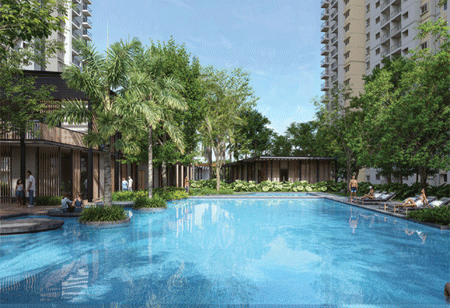
This decision preserved a substantial number of mature trees, reduced the carbon impact associated with excavation, and maintained the natural contours of the site. More importantly, it unlocked new opportunities for community-centric design. The terraces and rooftops above the parking structures were transformed into landscaped green spaces, rooftop farms, and social zones, turning infrastructure into usable, life-enhancing environments. What began as a design constraint ultimately became a defining feature, reinforcing trust, innovation, and long-term value.
Lifestyle Relevance and Enduring Community
Cloud Forest is designed to remain relevant across generations by focusing on enduring human needs rather than short-lived trends. Homes are planned to support evolving lifestyles, including work-from-home readiness and flexible living spaces. Wellness is not confined to fitness rooms, but is distributed throughout the landscape, featuring walking trails, cycling tracks, open-air activity zones, and serene green retreats that encourage everyday movement and mental balance. Community life is equally central to the project’s vision. Shared spaces such as amphitheatres, multipurpose halls, leisure pavilions, and landscaped gardens foster interaction across age groups.
Cloud Forest redefines urban luxury by blending orchard-led living, wellness-focused design, and effortless walkability into everyday life
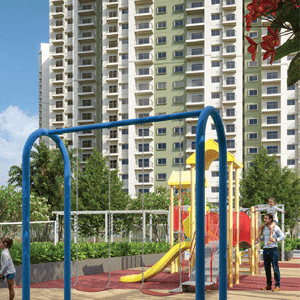
Children benefit from safe, shaded play areas and pedestrian zones, while seniors find comfort in accessible paths and resting spaces. Farm-to-table living, supported by organic farming zones and solar-powered rooftop vegetable gardens, reconnects residents with food, health, and sustainability in a tangible way. By integrating low-carbon mobility, water conservation systems, and energy-efficient planning, Cloud Forest reduces long-term environmental impact while lowering operational costs for residents.
Sustainability here is not a compliance exercise but a lived experience, where responsible choices become effortless daily habits. In conclusion, Cloud Forest stands as a live-in demonstration of how residential living can align with a hyperlocal, low-carbon urban future. By placing nature, community, and well-being at the centre of design, it offers a model of luxury defined not by excess, but by balance, resilience, and lasting quality of life.
AWARDS & CERTIFICATES • Alembic City, Bangalore (South Zone) won the Best Residential Project – Township award at The Economic Times Real Es-tate Conclave & Awards 2024.
We use cookies to ensure you get the best experience on our website. Read more...
Copyright © 2026 HomesIndiaMagazine. All Rights Reserved.