

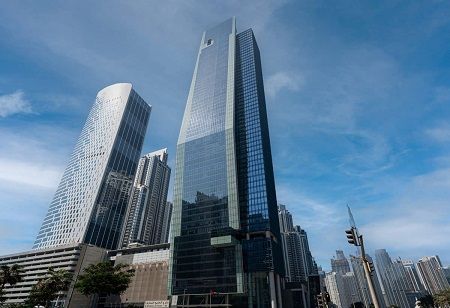
Dubai’s office market remained under pressure from strong demand and limited supply in Q2 2026, with Grade B office rents rising 31.5% year-on-year and Grade A rents increasing 26.2%. Falling vacancy and rising leasing activity are intensifying competition for quality commercial space.
Dubai’s commercial property market continued to tighten in the second quarter of 2026 as strong demand for office space coincided with limited availability. According to JLL data cited by Arabian Business, Grade B office rents increased 31.5% year-on-year, while Grade A rents rose 26.2%. Prime office rents also recorded a 13.6% annual increase, highlighting growing pressure across the market.
Dubai’s overall office vacancy rate fell to 6.1% in Q2 2026, compared with 7.7% a year earlier. The shortage was particularly visible in higher-quality buildings, prompting companies that could not secure prime space to consider Grade A and Grade B alternatives. Grade B vacancy declined to 8%, while Grade C vacancy fell to 10.9% during the period.
Also Read: How Lifestyle Amenities are redefining Residential Living in NCR
Demand for commercial space was also reflected in leasing activity. Office rental contract registrations in Dubai increased 24.6% year-on-year and 15.1% quarter-on-quarter, largely supported by new contracts. The growth indicates that companies continue to expand or establish operations in the emirate despite rising occupancy costs.
The supply-demand imbalance is being driven by Dubai’s continued business and population growth, alongside increasing demand for well-located, high-quality workplaces. As available premium inventory becomes increasingly limited, businesses are facing higher rents and greater competition for suitable offices. This trend is also encouraging some occupiers to explore flexible workspace solutions.
Flexible offices are gaining traction across Dubai and Abu Dhabi as companies seek shorter commitments, greater operational flexibility and lower initial costs. JLL also noted that artificial intelligence and automation are influencing workforce requirements and corporate real estate strategies, potentially changing how businesses plan and use office space.
The broader UAE commercial property market is also experiencing tight conditions. In Abu Dhabi, prime office availability dropped to just 0.1% in Q2, while overall office vacancy remained at 1.4%. Prime rents increased 11.7% annually, reinforcing the wider shortage of premium commercial space across the UAE.
Also Read: Why Demand for Budget and Luxury Homes is Rising Together
The latest figures underline Dubai’s strong commercial property momentum while highlighting the challenges created by constrained supply. With businesses continuing to seek high-quality workplaces, rental growth is expected to remain a key feature of the market as developers and occupiers respond to changing demand.
We use cookies to ensure you get the best experience on our website. Read more...
Copyright © 2026 HomesIndiaMagazine. All Rights Reserved.
