

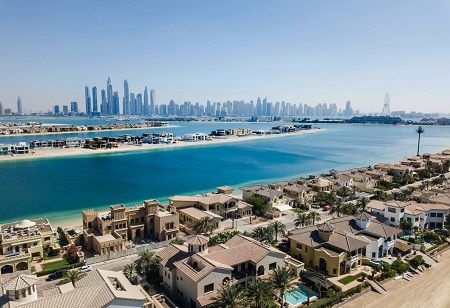
Dubai’s average residential property price fell 1.7% year-on-year to AED 1,636 per sq ft in August, marking the first annual decline since February 2021. Yet residential sales reached AED 23.4 billion during the month.
Dubai’s residential property market has recorded its first year-on-year decline in home prices since February 2021, signalling a shift towards a more measured phase after several years of strong growth. According to property consultancy Cavendish Maxwell, the average residential sales price fell to AED 1,636 per sq ft in August 2026, down 1.7% from a year earlier and 1.3% over the preceding three months.
The decline comes as Dubai’s housing market moves into a period of recalibration, with increasing supply and changing buyer dynamics influencing price growth. Cavendish Maxwell described the latest figures as evidence of a market transitioning into a more mature stage rather than an abrupt correction.
Also Read: How Connectivity and Lifestyle Trends Are Redefining NCR's Real Estate Market
Despite the decline in average prices, transaction activity remained substantial. Residential sales reached AED 23.4 billion in August, taking the cumulative value of residential transactions during the first eight months of 2026 to nearly AED 270 billion. This indicates that demand remains active even as price momentum has moderated.
The market’s performance also reflects a widening differentiation between property segments. Dubai’s luxury residential segment continues to attract high-net-worth buyers, while mainstream housing is experiencing greater sensitivity to affordability, inventory levels and broader economic conditions. Recent market data has shown continued demand for premium homes even as the wider residential market loses some momentum.
The cooling trend follows several years of rapid appreciation, supported by population growth, international investment, strong employment activity and Dubai’s position as a global business and lifestyle hub. However, the increasing pipeline of new residential developments is expected to create greater competition among properties and moderate price growth.
Market conditions have also been influenced by wider geopolitical and economic uncertainty across the region. While Dubai has historically demonstrated resilience during periods of volatility, changes in investor sentiment can affect transaction volumes and purchasing decisions, particularly among international buyers.
Also Read: Gurgaon Shaping the Future of Luxury Real Estate for Homebuyers
The latest figures suggest that the emirate’s property market is entering a more balanced phase. Developers and investors may increasingly need to focus on location, product differentiation, pricing and end-user demand rather than relying solely on broad-based market appreciation.
For buyers, the moderation in prices could create greater negotiating opportunities in selected segments, while investors are likely to assess rental yields and long-term fundamentals more closely. The continued strength of transaction values, however, indicates that Dubai remains an active real estate market despite the latest price decline.
We use cookies to ensure you get the best experience on our website. Read more...
Copyright © 2026 HomesIndiaMagazine. All Rights Reserved.
