

Something changed in the premium residential market that's hard to pin to a single moment. Buyers started asking different questions.
Not just square footage and specification - those conversations still happen - but something harder to quantify. Whether the home feels like somewhere to actually live or like a demonstration of what expensive finishes look like. Whether the privacy genuinely works. Whether the technology is integrated or obviously added on. These aren't questions a brochure answers well.
What's Actually Being Evaluated
The signal markers of luxury still matter. Marble, high ceilings, imported kitchen systems, premium fittings - none of this has stopped mattering. What's changed is that it's no longer sufficient on its own.
The Problem With Separate Decisions
Here's what usually goes wrong in luxury interiors: materials get selected in different showrooms on different days, furniture gets chosen after the finishes are committed, lighting gets specified late, and nobody reviews how all of it reads together in the actual room.
A stone sample in a showroom looks different from the same stone under the specific lighting conditions of the room it's going into. A furniture arrangement that fits the measured floor plan can still feel wrong once the pieces arrive, because scale on paper and scale in space are different experiences. A ceiling treatment chosen without reference to the wall finish it sits above can produce a room that feels competitive with itself rather than resolved.
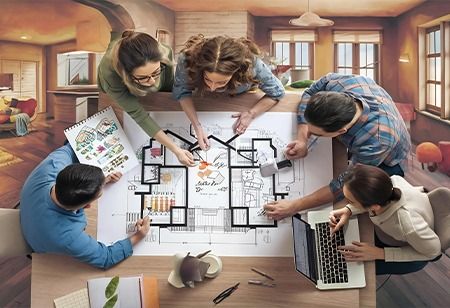
In luxury residential projects, design decisions rarely work in isolation. Layout, lighting, textures, furniture scale, ceiling design, wall finishes, and material palettes all shape how the home will feel. Interior rendering can help homeowners, designers, and developers review these choices before execution begins — when adjustments are still changes to a file rather than changes to a finished room.
Layout Gets Less Attention Than It Deserves
The instinct in luxury residential projects is to focus on finishes. Layout is more invisible and more consequential.
How does movement actually work through this home on a weekday morning? Not on a day when everything goes perfectly — on a regular day when multiple people are using different parts of the house simultaneously. Is the kitchen positioned so that someone cooking doesn't feel separated from conversation in the living area? Are the bedroom wings genuinely separated from the entertaining spaces, not just technically distant? Can household staff move through service routes without crossing the main living areas?
A layout that doesn't answer these questions well will make itself felt every day, regardless of what the marble cost.
Light Changes Everything Else
Lighting is the most consistently underspecified element in luxury interior design, which is strange given how much it determines about the finished result.
Morning sun comes from a specific direction at a specific angle. A room that faces east will have one quality of natural light in the morning and a completely different atmosphere by afternoon. The stone or wood or plaster chosen under the artificial light of a showroom behaves differently under the actual daylight conditions of the room it's going into. A warm light source reads the same stone surface very differently from a cool one - and if the lighting temperature varies room to room without a considered reason, materials that looked coherent on a specification board can look disconnected in the finished interior.
Statement fixtures matter. The full lighting strategy - how ambient, task, and accent layers interact with the materials and with each other - matters more.
Materials Need an Overview
Luxury interiors that feel resolved are almost always the ones where someone held the whole material palette in view simultaneously.
Marble flooring, solid timber joinery, brass hardware, textured wall panels, soft furnishings in a particular colour register: these can work together beautifully. Introduce one element that belongs to a different visual logic - a high-gloss finish that reads as a different decade, a wall treatment that was chosen independently of the floor it sits above - and the room starts to feel like it's arguing with itself.
In practice, when clients are procuring different elements through different designers, showrooms, and contractors, coherence doesn't happen automatically. Someone needs to be looking at everything at the same time.
Technology That Feels Native
Smart home features are now standard expectations at the premium end: lighting automation, climate systems, motorised blinds, integrated audio, security and access control. The design challenge isn't whether to include them. It's whether they feel like they belong to the interior or were installed after the interior was finished.
A control panel placed without considering the visual composition of the wall around it. Visible conduit because cabling routes weren't mapped during design. Cameras and speakers positioned for technical coverage rather than for how they read in the room. None of these are catastrophic failures individually. Together they produce an interior that reads as technically capable but not fully designed.
When technology planning starts at the same time as spatial and material planning rather than after it, the result is a home where the smart elements feel genuinely integrated.
Privacy as Architecture
Security and privacy in luxury homes are often treated as a procurement question - gates, systems, cameras. They're also a spatial design question.
How is the home organized so that residents have genuine control over the experience? Which spaces are reception spaces and which are genuinely private? How do service routes function without intersecting with the main living areas? Is the primary suite acoustically and visually separated from where guests are received? These are layout questions as much as security questions, and they determine whether the privacy of the home feels designed in or bolted on.
The Hospitality Influence
The clearest shift in luxury residential design over the past decade is the influence of high-end hospitality. Not in the sense of making homes look like hotels — at its worst, that's exactly what happens - but in the functional ambition that hospitality design embodies.
A hotel lobby that works well creates a particular quality of ease through the relationship between space, proportion, light, material, and the absence of unnecessary elements. The same logic applied to a residential entry hall, a living room, or a primary bathroom produces a space that feels considered rather than expensive. Layered materials, curated lighting, proportions that give the room breathing space: the techniques are the same.
What to Look At Before Approving a Design
The review that matters most before a luxury interior goes into execution isn't the specification check. It's the experience check.
Does the layout actually support the daily life of the people who'll live there? Do the materials read as a coherent whole rather than individual selections? Does the lighting strategy suit the materials, not fight them? Are the technology elements genuinely integrated? Does the privacy logic work spatially? Does the space feel personal rather than generic?
Answering these questions before execution costs very little. Answering them after is considerably more expensive.
We use cookies to ensure you get the best experience on our website. Read more...
Copyright © 2026 HomesIndiaMagazine. All Rights Reserved.
