

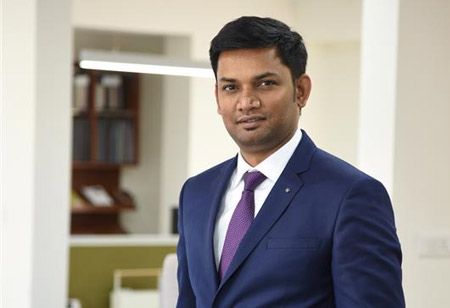
In an interaction with Homes India Magazine, Vamsidharr Setty, Managing Director India, The Senator Group, shares his valuable insights on how office spaces need to evolve and catch up with new and ever changing work patterns.
Under the leadership of Vamsidharr Setty, The Senator Group India, since setting up its first showroom at Bangalore in 2018 with two premium and high-quality brands Senator and Allermuir, has grown to become a name to reckon with in the Indian Office Furniture Industry.
How are organisations redefining the purpose of the office in hybrid and distributed work models, and what role does physical space now play in talent retention and performance?
The work place is being questioned in ways it has never been before not just in regards to policy or real estate, but deeper, more fundamental.
Offices were structured based on efficiency and density and the rows of desks and strict layout were the new standards over decades. Nevertheless, the changing working patterns have revealed a historic design weakness: most offices were furnished to be attended and not experienced.
Also Read: Post-Budget Impact on India's Real Estate: Trends & Outlook
How do you quantify the impact of ergonomic and behavioral furniture design on employee productivity, wellbeing, and organizational outcomes?
Furniture is one of the most underrated aspects at the centre of this transformation. It is not merely a layer that is finished but one of the limited physical components that the body interacts with during the day. Furniture takes on the aspects of posture, comfort, movement and mood and it cuts across ergonomics, psychology and spatial behavior. In most aspects we never just use furniture but live with it.
The choice and placement of furniture define the manner in which people move in the spaces, where they congregate, rest, or withdraw. It affects the feeling of natural collaboration or forced collaboration and it affects the feeling of a formal space, relaxed space, social space or institutional space. In this regard, furniture becomes behavioral infrastructure in a silent manner that influences the operation of workplaces.
The last several years contributed to the increased awareness of this correlation. Working at home (at dining tables or improvised desks) made the population more aware of the impact of the environment and its influence on concentration, vitality, and health. Going into the office is not automatic anymore, the employees compare it to comfort and control they received at other places. Offices must thus supply something which cannot be readily produced at home-- and that something is experience, produced by space.
What furniture typologies and spatial formats are proving most effective in supporting collaboration, learning, and hybrid meetings in modern workplaces?
The modern day office is not a place of work but more of group work, education, mentoring, and socializing. Although it is possible to carry out the focused work anywhere, teamwork and joint thinking demand the corresponding environment. However, most offices continue to use furniture structures that accommodate inert desk activities - a design that is out of touch with the reality of human working patterns.
This is where design thinking is needed. It is no longer a question of whether we have enough desks, but instead of that, should our furniture facilitate many forms of interaction? Is it possible to work on it, have non-structured conversations, planned meetings, virtual meetings, and rest and resettlement? In the absence of such diversity, the most visually modern work environment stands chances of operating in ways that are outdated.
Culture is also expressed through furniture, which can be even more effective than branding. Areas consisting of the same seats and strict designs are associated with standardization and order, whereas areas with different seats, common tables, and informal positions are more comfortable, adjustable, and trustworthy. Such signals have a long-lasting effect on behavior before any company policy.
Also Read: Mid-Market Hotels and Tech Redefine South India Hospitality
How can organisations leverage furniture-led interventions to future-proof workplaces without major structural or real estate investments?
This is a major opportunity for designers. In contrast to architectural interventions, furniture-based strategies have the ability to change the way a room functions without changing the building shell. The careful design, typology, and material selection can allow designers to provide a sense of interaction, privacy levels, and different energy levels on the same footprint.
This is not concerned with inclusion of lounge furniture which is aesthetics. It is of conscious spatial arrangement - planning movement between working modes, by chance, ergonomic variety, and sensual comfort. The quality of interactions in a workplace is now used to gauge its success rather than its fullness.
This is a unique time in the history of workplace design because it enables us to break with the past. The office is not being replaced but its function has evolved. There is more than cosmetic redress to this change, it demands more spatial purpose.
Furniture, regarded as the last stage, is actually among the strongest tools that designers have their hands on. It is the quickest way of shaping behaviour than architecture and communicates culture more directly than graphics.
Finally, the discussion on the office of the future is not a real estate issue but a human experience issue. Individuals have come to know that the workplace influences their vitality, health, and identity. They will not voluntarily go back to places where this is disregarded. Furniture is the most human-sized of all designs, the meeting point of body and space on a daily basis. Ignoring that layer means ignoring the very individuals that workplaces are intended to help.
We use cookies to ensure you get the best experience on our website. Read more...
Copyright © 2026 HomesIndiaMagazine. All Rights Reserved.
