

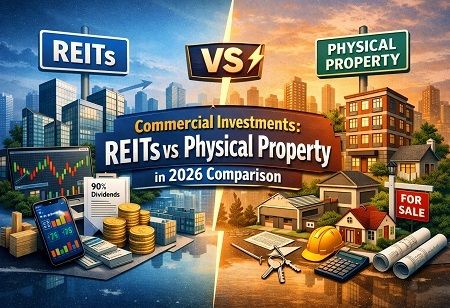
As commercial real estate trends in 2026 continue to evolve, the debate around REITs vs. Physical Property in 2026 is becoming central to modern investment strategies.
With the rise of digital economies, hybrid work models, and institutional-grade real estate products becoming accessible to retail investors, commercial real estate is no longer a one-size-fits-all opportunity.
Investors today are not just asking where to invest. But also, how much control do they need? How liquid should their investment be? And how efficiently can it generate income?
This shift has positioned REITs as a powerful alternative to traditional property ownership, while direct real estate continues to hold its ground as a long-term wealth-building asset.

The global commercial real estate market is stabilizing after years of disruption, but with clear sectoral winners:
These trends are critical because they influence both REIT portfolio performance and direct property returns.
REITs are projected to deliver ~6% FFO growth in 2026, supported by:
Unlike individual property owners, REITs benefit from portfolio diversification, which cushions sector-specific downturns.
One of the most transformative developments in 2026 is the emergence of SM-REITs with entry points around ₹10 Lakhs. These instruments are:
This trend is particularly strong in India and other emerging markets.
We use cookies to ensure you get the best experience on our website. Read more...
Copyright © 2026 HomesIndiaMagazine. All Rights Reserved.
