


India’s PropTech sector has moved decisively beyond basic digitisation and workflow automation into a far more transformative phase defined by agentic AI ecosystems.
In 2026, the competitive advantage no longer lies in simply digitising listings or enabling online transactions, but in deploying AI systems that can independently execute complex real estate functions.
These systems are actively handling customer conversations across voice and WhatsApp, scheduling site visits, managing leasing cycles, abstracting legal documents, dispatching maintenance, and even optimising energy usage and compliance reporting.
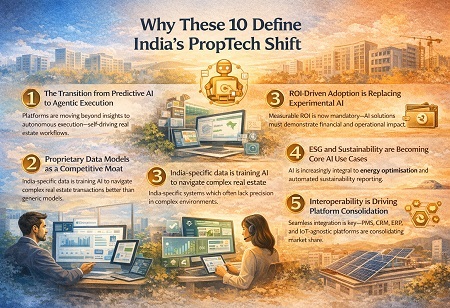
The most defining characteristic of India’s PropTech evolution in 2026 is the shift from predictive intelligence to execution-driven systems. Earlier AI tools focused primarily on insights—pricing predictions, demand forecasts, or lead scoring. However, the platforms leading today’s market are those that act on those insights autonomously, executing workflows without requiring constant human input. Companies like TheHouseMonk and NoBroker illustrate how AI can independently manage leasing, communication, and operational processes, significantly reducing turnaround times and enabling scalable growth.
A defining advantage for leading PropTech firms is their investment in proprietary, domain-specific datasets that train highly contextual AI models. Unlike generic systems, which often lack precision in complex environments, platforms such as Landeed and Aurum PropTech leverage structured regulatory, transactional, and behavioural data unique to India. This allows them to deliver more accurate insights, reduce risk in decision-making, and operate effectively within the country’s fragmented and highly nuanced real estate ecosystem.
AI adoption in Indian real estate has matured into a results-driven strategy where measurable outcomes take precedence over experimentation. The most successful platforms demonstrate clear financial and operational benefits, including higher conversion rates, reduced operational costs, and faster execution cycles. Solutions such as Sell.Do and TheOfficeMonk exemplify this shift by consistently delivering tangible efficiency gains, making AI an indispensable component of modern real estate operations rather than a supplementary tool.
Sustainability considerations are increasingly shaping the real estate sector, driven by regulatory mandates and investor expectations. AI is playing a pivotal role in enabling compliance and improving environmental performance through real-time monitoring, predictive maintenance, and automated reporting. Platforms like Aurum PropTech and TheOfficeMonk are integrating IoT with AI to create intelligent building systems that optimise energy usage while simplifying ESG compliance, positioning assets for long-term resilience.
As technology adoption deepens, interoperability has become a critical requirement for real estate platforms. Companies that can seamlessly integrate with existing PMS, CRM, ERP, and IoT systems are gaining a significant competitive edge. This has also accelerated consolidation within the industry, as integrated platforms reduce fragmentation and improve operational efficiency. The ecosystem-driven approach of Aurum PropTech highlights how interconnected solutions are shaping the future of PropTech, paving the way for unified and scalable operating systems.
Here’s a breakdown of how AI is delivering measurable ROI across core real estate workflows in India:
|
Use Case |
Traditional Approach |
AI-Driven Outcome |
Efficiency Gain |
|---|---|---|---|
|
Leasing & tenant onboarding |
Manual calls, site coordination |
Automated via TheHouseMonk |
30–35% faster cycles |
|
Customer service & brokerage |
Agent-led conversations |
AI agents via NoBroker |
25–40% automation |
|
Sales conversion |
Manual lead qualification |
AI scoring via Sell.Do |
+25–30% conversions |
|
Title verification |
Days of document review |
AI parsing via Landeed |
Days → minutes |
|
Building operations |
Reactive maintenance |
Predictive via TheOfficeMonk |
~30% OPEX reduction |
|
Construction procurement |
Manual forecasting |
AI-driven via Infra.Market |
Reduced delays & costs |
Also Read: How Proptech is Transforming Data into Meaningful Relationship Management Strategies
The Indian real estate technology landscape in 2026 is undergoing a fundamental transformation, where the focus has shifted from tools that assist humans to systems that operate alongside—or even independently of—them. The companies leading this transition are not defined by the size of their listings or marketplace reach, but by the capability of their AI systems to execute real-world tasks with speed, accuracy, and minimal human intervention.
From engaging customers and managing assets to verifying transactions and optimising building performance, these platforms are redefining operational efficiency across the value chain. This evolution signals the emergence of PropOS, where real estate is no longer just digitised but autonomously managed through intelligent, interconnected systems.
We use cookies to ensure you get the best experience on our website. Read more...
Copyright © 2026 HomesIndiaMagazine. All Rights Reserved.
